The Moon Itself Has Not Grown
The moon near the horizon looks bigger than the moon high in the sky. This is called the moon illusion. But the size the moon casts on your eye (its apparent angle) is nearly the same just after rising and straight overhead, about 0.5 degrees. If anything, the moon at the horizon is farther from the observer by about an Earth radius, so it casts a slightly smaller image.
Photographs show no difference. Take the horizon moon and the high moon with the same settings and put them side by side, and the sizes are almost the same. What looks bigger is not outside the eye but the brain, which judges size from the image it sees.
How to Check It Yourself
| Method | What to do | What you learn |
|---|---|---|
| Measure with a small hole | Hold a coin with a hole (such as a Japanese 5-yen coin) or a small ring at arm’s length and look at the moon through the hole. Try both the horizon moon and the high moon a few hours later | Both roughly fit in the hole. The size it casts does not change |
| Look through a tube | Roll up paper into a tube so that only the moon is visible | When the surrounding scenery disappears, the feeling of bigness weakens |
| Take photos | Fix your phone’s zoom at the same level and shoot twice, some hours apart | The size on the screen is the same |
| Tilt your head or look upside down | Tilt your head, or bend over and look between your legs | Many people say the look weakens. It varies by person |
The second method is the most important clue. It suggests that seeing the horizon and buildings is what makes the moon look bigger.
Why It Looks Bigger — the Main Theories
The cause of the moon illusion is still not settled. The leading theories are below, and some researchers think several overlap.
| Theory | Idea | Figure to try on this site |
|---|---|---|
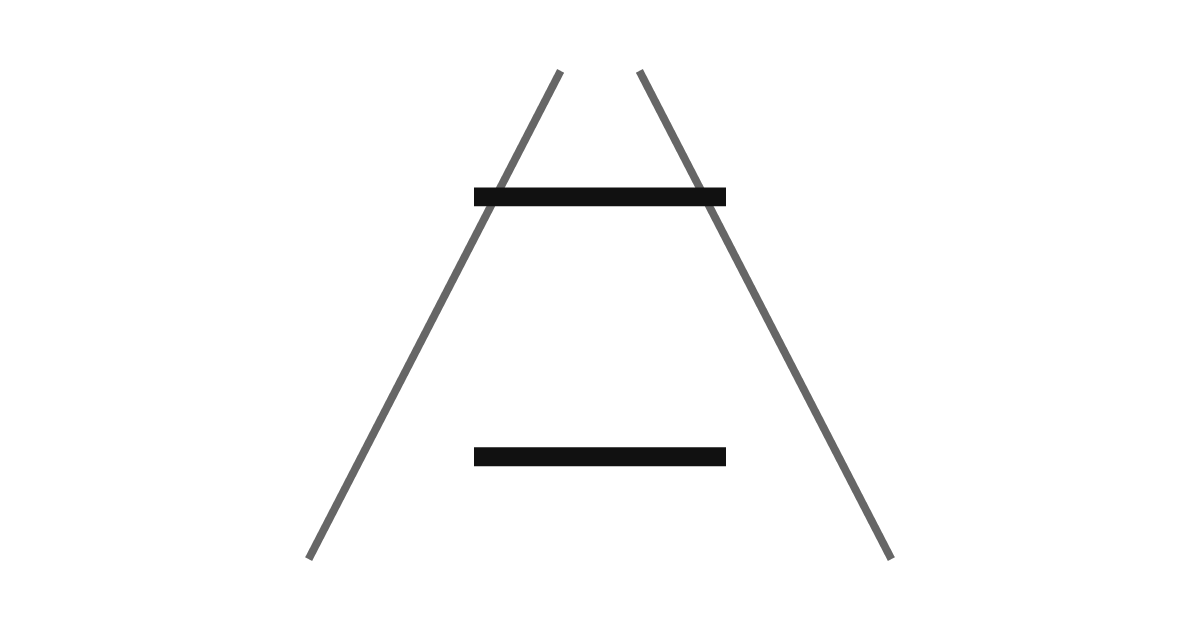
| Apparent distance | You feel the sky as a flattened dome and judge the horizon as farther. Something that casts the same size is judged larger the farther away it is | Ponzo Rails |
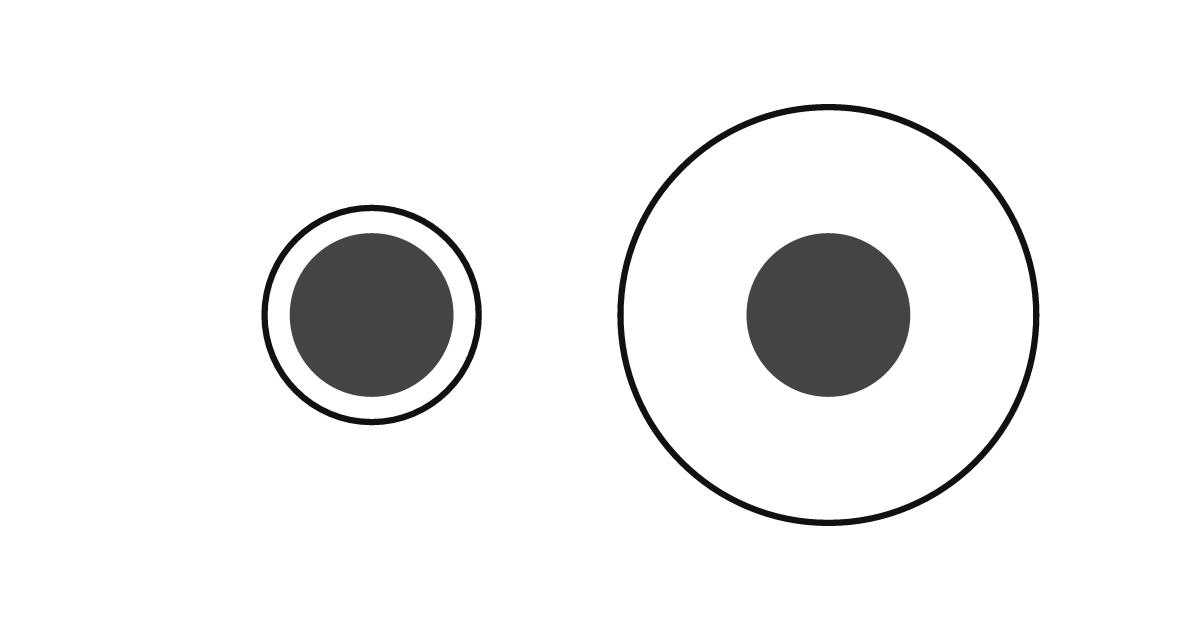
| Comparison with surroundings | The horizon moon sits next to far-off trees and buildings that look small. Surrounded by small things, the middle object looks big | Ebbinghaus |
| Eye direction and posture | Looking up or looking straight ahead changes how big things feel | — |
The apparent distance theory works in the same way as the Ponzo Rails. In the Ponzo illusion, two lines narrowing into the distance act as a cue for “far”, and the bar that sits farther looks longer. The ground and the cityscape out to the horizon are thought to play the same role.
The comparison theory is close to the Ebbinghaus and Delboeuf Circles. A moon in the middle of an empty night sky has nothing to be compared with.
Common Misconceptions
- “The air acts as a lens and magnifies it” — No. Atmospheric refraction only flattens the horizon moon slightly from top to bottom; it does not enlarge it. This is why a setting sun or rising moon can look like a slightly wide oval
- “The horizon moon is closer to Earth” — No. As written above, it is slightly farther
- “There are days when it is big because of the moon’s orbit” — There are days when the distance between the moon and Earth changes and it really looks bigger (the so-called supermoon), but the distance changes slowly over a cycle of about a month. That is a separate matter from the moon illusion, where the size changes within a single night between the horizon and high in the sky
If You Make It a Science Project
- Use the hole method to check that “the size it casts is the same”. This is the starting point
- Change only one condition. With or without the tube, a place where buildings are visible or not
- Ask several people “how much bigger does it look?” and record the answers. Impressions vary by person
- Look for a similar phenomenon on paper. With the Ponzo Rails figure, check with a ruler that bars of the same length look different
For other everyday examples, see Everyday Optical Illusion Examples, and for how size illusions work, see Size and Context.