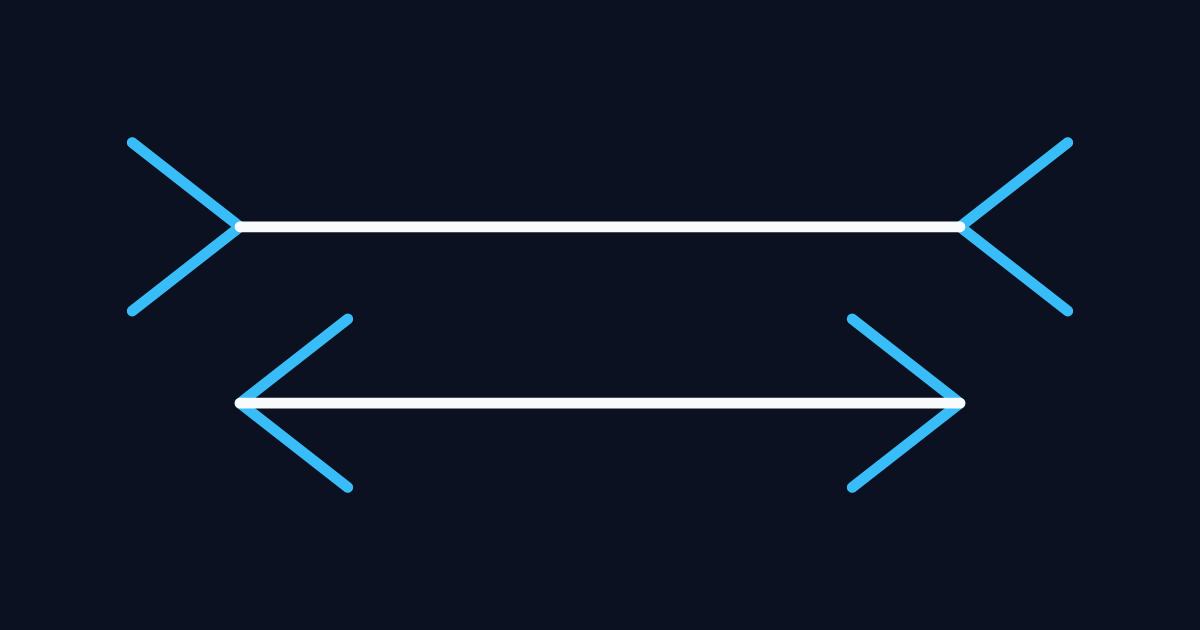
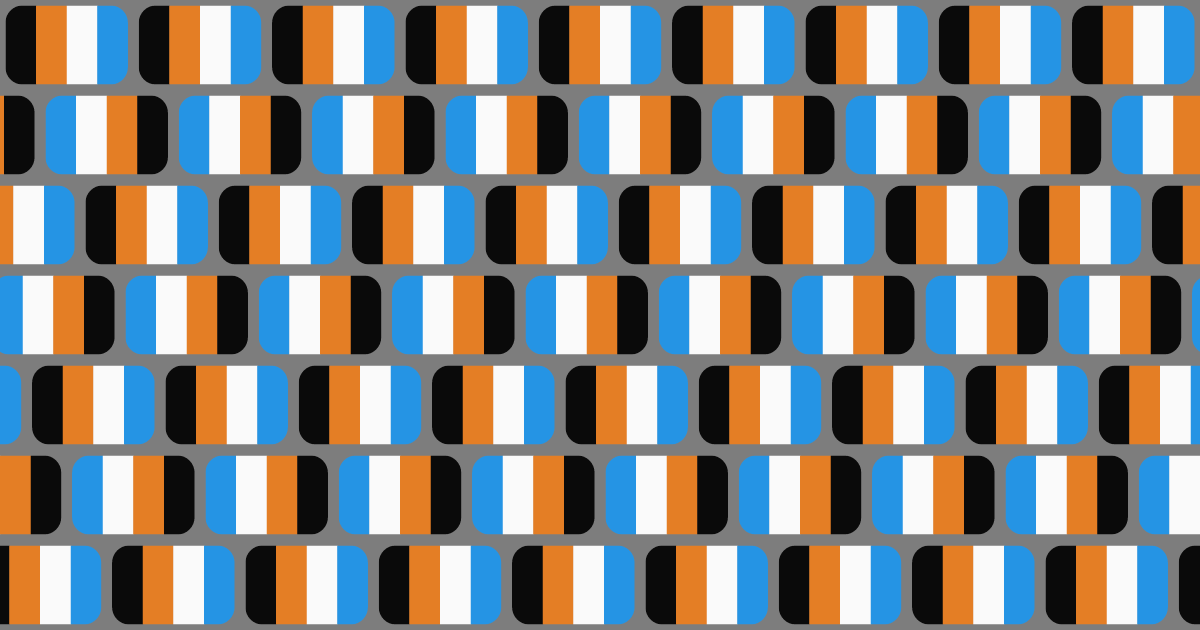
An optical illusion is a phenomenon where length, size, brightness, colour, motion and so on look different from the actual (measured) value. Of what is commonly called an “illusion of the eyes”, it refers to those that involve seeing. Unlike a misreading you can avoid by paying attention, the mark of an optical illusion is that it looks just as different even if you know how it works, even after you measure it with a ruler.
Illusion in General vs Optical Illusion
An illusion (perceptual illusion) is a general term for the phenomenon of sensing something different from reality, across all the senses: seeing, hearing, touching and so on. Those that involve seeing are called optical illusions. The Shepard tone, a sound that seems to keep rising in pitch, is an illusion but not an optical illusion.
What Lands on the Retina Is Not “the Answer”
All that reaches the eye is a two-dimensional pattern of light. Working out from it the 3D world, the sizes of things, and their true colours is a problem with no single answer in principle. The visual system fills this gap by guessing.
An optical illusion is the moment when the rules of that guessing become visible. So it is more accurate to think of an illusion not as a failure but as the spec sheet of a guess that normally works well.
Types of Optical Illusions
How illusions are classified differs between researchers, but sorting them by “what looks different” makes them easy to organise.
| Type | What looks different | Typical illusions |
|---|---|---|
| Geometric illusions | Length, size, angle, straightness | Müller-Lyer, Ebbinghaus, Zöllner Lines |
| Brightness and colour illusions | Brightness, colour | Simultaneous Contrast, Checker Shadow, Munker Colors |
| Motion illusions | Still things look like they move | Drifting Tiles, Frozen but Moving |
| Ambiguous figures | One figure looks two or more ways | Vase or Faces, Necker Cube, Reversing Ring |
| Subjective contours | A shape appears with no line | Kanizsa Triangle |
| Adaptation and gaze illusions | Things vanish when stared at, dots appear | Fading Dots, Scintillating Grid |
| Spatial frequency illusions | What you see changes with viewing distance | Hidden Text |
How each type works is covered in more detail in explainers such as Size and Context, Brightness and Color and Ambiguous Figures.
Why Do Optical Illusions Happen?
The cause differs from illusion to illusion, but most are explained by one of the following three (or a combination).
- The rules of guessing backfire. The visual system corrects what it sees with rules such as “far things look small” and “things in shadow look dark”. Apply the rules to a figure that needs no correction, and length or brightness looks off (Ponzo Rails, Checker Shadow)
- Judgement by comparison with the surroundings. Both size and brightness are evaluated not alone but by the difference from neighbours (Ebbinghaus, Simultaneous Contrast)
- Properties of eye and nerve processing. Properties such as getting used to the same stimulus and sensing it less, emphasis of brightness boundaries, and processing speed that differs by place become visible (Fading Dots, Mach Bands)
All of these are functions that help you see ordinary scenery correctly. An optical illusion can be said to be what happens when they stand out in a specially made figure.
What They Share Is “Context”
Whatever the classification, what happens is similar. The visual system does not evaluate a target alone; it evaluates it by its relationship to the surroundings.
- The length of a line is judged together with the shapes on its ends
- Colour is judged by the difference from adjacent colours
- Motion arises from differences in the processing speed of adjacent luminance edges
An illusion figure simply manipulates this “surrounding” artificially to shift the evaluation.
The same shift happens in everyday scenery. Examples such as the same clothes looking a different colour are in Everyday Optical Illusion Examples, and why the horizon moon looks big is in The Moon Illusion.
If you want to approach from the side of works that use illusions, read What Is Trick Art?, and for why flat pictures seem to pop out, read 3D Illusions.